




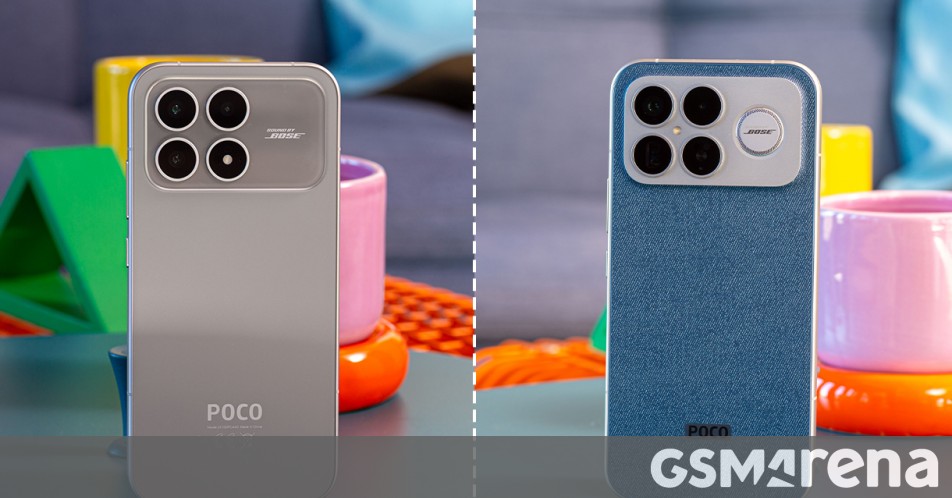
Xiaomi has clearly segmented the Poco F8 Pro and the Poco F8 Ultra, with deliberate hardware and feature differences between the two. The Ultra is objectively the better phone in almost every way, but is it enough to justify the price gap? The F8 Ultra is asking €180-200 more than its sibling, so let’s see if it really deserves them.
Table of Contents:
For starters, you can compare the complete specs sheets or directly continue with our editor’s assessment in the following video or in the following text.
Size comparison
The Poco F8 Pro and the F8 Ultra share similar design language, but differ in other ways. Interestingly, many of you will consider the Pro to have the more premium choice of materials of the two as it incorporates a glass back and aluminum frame with a Gorilla Glass 7i protective sheet on the front.
The F8 Ultra, on the other hand, has a Poco Shield Glass on the front, an aluminum frame, and either a fiber-reinforced plastic back or a silicone polymer back. The latter is the Denim Blue variant, but don’t be fooled by the looks – it’s actually pretty rubbery to the touch.
Aside from the difference in the build, there’s a notable disparity in dimensions. Naturally, the Poco F8 Pro is lighter and more compact as it houses a smaller display. So if you like compact phones more, do keep this in mind.
Display comparison
Size difference aside, the two handsets feature almost identical displays. Both Pocos reach more than 1,000 nits at 75% fill and about 3,500 nits at 10% fill. HDR certifications are also identical – HDR10+ and Dolby Vision.
Battery life
The Poco F8 Ultra edges out the F8 Pro with a slightly bigger battery, which in turn means a bit longer battery life, too. Interestingly, there’s little to no difference in the call and gaming runtimes, but the F8 Ultra gains an advantage in the web and video playback tests.
Still, at the end of the day, the difference in the overall Active Use Score is borderline negligible.
Charging speed
Both Pocos support the same 100W HyperCharge proprietary charging standard by Xiaomi, and unsurprisingly, the two handsets post comparable charging times. Probably due to its slightly larger battery, the F8 Ultra charges by a couple of percentage points slower than the F8 Pro at the 15 and 30-minute marks.
One notable difference between the two handsets is that the F8 Ultra supports Xiaomi’s fast 50W wireless charging.
Speaker test
According to the specs sheet, the Poco F8 Pro and the F8 Ultra feature the identical stereo speakers, tuned by Bose. However, there’s a notable distinction between the two audio systems – the F8 Ultra features “a subwoofer,” a built-in speaker with a size that is usually found in tablets and not phones. This, in turn, makes the F8 Ultra’s sound fuller and warmer, and with more pronounced bass. In fact, the F8 Ultra’s speakers are among the best we’ve heard from a phone in recent times.
On the other hand, the F8 Pro is much louder and may be more adequate for podcasts and video, with its flatter sound and bias toward vocals and mids.
Performance
As per usual, the Pro version gets last year’s flagship chipset from Qualcomm, namely the Snapdragon 8 Elite, and the Ultra gets the newest one – the Snapdragon 8 Elite Gen 5.
Perhaps for most users, this won’t make much of a difference, but given that Qualcomm’s latest advancements in its chips are anything but trivial, it’s important to see how much better the Ultra is.
When it comes to storage, the two handsets are nearly identical. Both ship with the same default memory variant – 12GB/256GB and offer up to 512GB UFS 4.1 storage. However, the Ultra’s higher-tier memory option has 16GB of RAM instead of 12GB.
Benchmark performance
As we already pointed out, the performance difference isn’t trivial. The Poco F8 Ultra’s newer SD 8 Gen 5 chipset is 26% faster in the CPU-only benchmarks, but shows a 13% leap in GPU-heavy workloads like 3DMark Wild Life. In the combined AnTuTu 10 benchmark, the newer SoC posts less than 10% improvement.
All in all, both devices will handle pretty much everything you throw at them – from heavy apps to modern games with sophisticated graphics. The F8 Ultra’s higher performance can be seen as a hedge against aging and will supposedly have a slightly longer life cycle.
On the software side of things, both devices come with HyperOS 3, which is based on Android 16, and Xiaomi promises 4 major OS upgrades and 6 years of security patches.
Camera comparison
The Poco F8 Ultra has a better camera system. It features a larger main sensor, a telephoto camera with a longer optical zoom (5x vs. 2.5x) and an ultrawide camera with higher resolution and again a larger sensor.
The front-facing camera of the F8 Ultra is also seemingly more potent with 32MP resolution as opposed to the 20MP one on the F8 Pro.
Image quality
The Poco F8 Pro and F8 Ultra both produce very similar images with their main cameras, but at the end of the day, the F8 Ultra’s stills are nicer. They are sharper, more detailed and have nicer definition overall, especially in poorly-lit areas or indoors. Contrast also seems to be more adequate indoors.











F8 Pro (0.6x) • F8 Ultra (0.7x) • F8 Pro (1x) • F8 Ultra (1x)
The ultrawide camera on the F8 Ultra is also better as it has higher resolution with more details and a more natural rendition. The 8MP ultrawide camera on the F8 Pro outputs oversharpened stills that look unnatural. On the other hand, the F8 Ultra’s ultrawide unit isn’t as wide, so you get a wider FoV with the F8 Pro and better contrast, too.












F8 Pro (2.5x) • F8 Ultra (2x) • F8 Pro (5x) • F8 Ultra (5x)
Since the Poco F8 Pro’s dedicated zoom camera has a similar focal length (60mm) to the F8 Ultra’s 2x crop from the main camera (48mm), we decided to compare them side by side.
Surprisingly, the 2x crops from the F8 Ultra turned out nicer in pretty much every situation. They are sharper, more detailed, with more accurate color temperature and better contrast.
Even though it’s normal to expect the dedicated 5x zoom camera on the Ultra to outperform the 5x crops from the F8 Pro, we are surprised to see the latter getting pretty close in terms of overall quality. Still, we’d pick the F8 Ultra as it produces sharper images with better contrast – the gap, however, is surprisingly small in good light.
At night, we prefer the F8 Ultra’s rendering once again and it’s much better here. The scenes have more detail in general, especially in the shadows, and contrast is better, too.












F8 Pro (0.6x) • F8 Ultra (0.7x) • F8 Pro (1x) • F8 Ultra (1x)
Both ultrawide cameras are a bit too fuzzy at night, but to our surprise, the F8 Pro’s 8MP shooter does better in some aspects. It’s sharper and captures more accurate color temperature.












F8 Pro (2.5x) • F8 Ultra (2x) • F8 Pro (5x) • F8 Ultra (5x)
Yet again, we see a better showing from the Ultra’s main camera at 2x crop compared to the dedicated 2.5x zoom camera on the Pro. Images are generally sharper, cleaner, with more accurate color reproduction and color temperature. The same goes for the 5x zoom photos, where the F8 Ultra outperforms the 5x crops from the F8 Pro by a significant margin.
And as for the selfies, we struggle to find any meaningful difference. Both selfie shooters deliver somewhat unimpressive photos, but neither comes out as “better”.




Selfies: F8 Pro • F8 Ultra
Video quality
Below we have a few framegrabs from the videos taken by the two phones at each focal length, so it’s easier to compare them to one another.
When it comes to videos, there’s no clear winner. Unexpectedly, the ultrawide videos from the F8 Pro’s camera are a tad better as they are somewhat sharper despite being 1080p.
When comparing 4K videos from the main cameras, the quality appears to be identical, with no particular phone coming on top.
In the dark, the nighttime videos from the F8 Ultra’s main cam have better dynamic range and less noise.








Video screengrabs: F8 Pro (0.6x) • F8 Ultra (0.7x) • F8 Pro (1x) • F8 Ultra (1x) • F8 Pro (2.5x) • F8 Ultra (2x) • F8 Pro (5x) • F8 Ultra (5x)
The 2x vs. 2.5x zoom comparison is nuanced. During the day, the two phones record similar videos, but at night, the Pro’s 2.5x zoom camera captures sharper and less noisy footage with better contrast.
At 5x zoom, the Ultra’s footage has more detail and better sharpness during the day and at night, although the nighttime videos from both phones aren’t particularly impressive.








Video screengrabs: F8 Pro (0.6x) • F8 Ultra (0.7x) • F8 Pro (1x) • F8 Ultra (1x) • F8 Pro (2.5x) • F8 Ultra (2x) • F8 Pro (5x) • F8 Ultra (5x)
Verdict
It’s quite evident that the F8 Ultra is the better phone, as Xiaomi intended. It’s faster, has a bigger screen, slightly longer battery life, better-sounding speakers and a more potent camera setup with some small exceptions.
As it currently stands, the F8 Ultra goes for about €180 more than the F8 Pro, which means the only reason you’d want to pick the F8 Pro over the Ultra is if you have a limited budget or you strongly prefer more compact phones, even though the Pro isn’t compact by definition.
- The more compact size.
- The largely similar user experience.
- The lower price.
- Glass back & Gorilla Glass 7i front
Get the Xiaomi Poco F8 Pro for:

- The much better 2.1 speaker setup.
- The larger display.
- The more powerful chipset.
- The slightly longer battery life.
- The wireless charging support.
- The overall better cameras.