




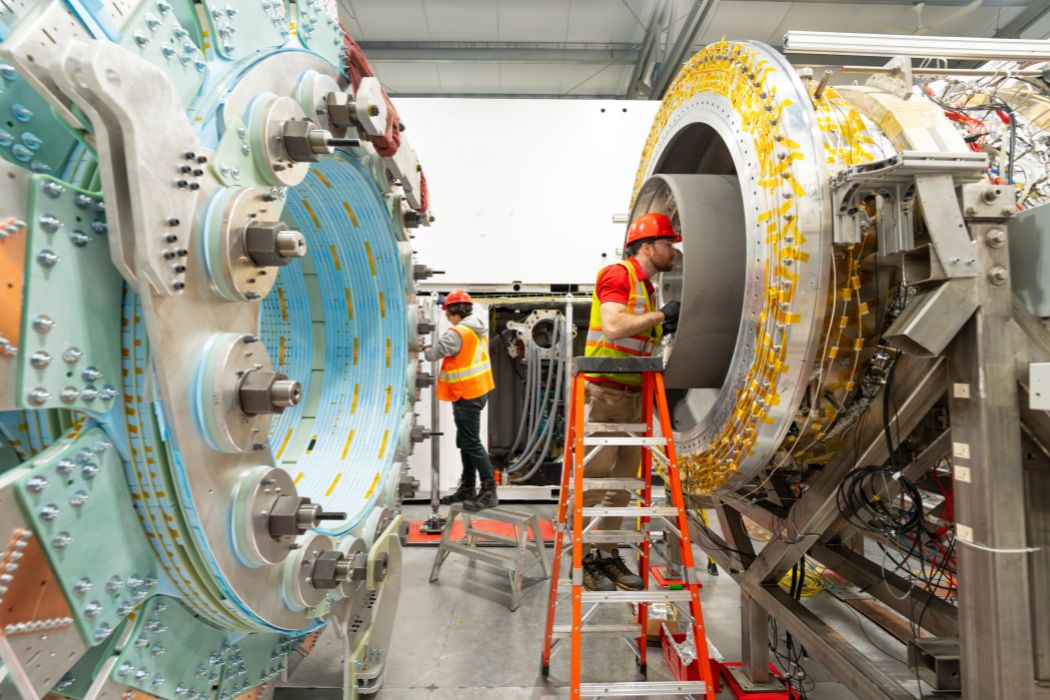
Richmond, BC-based firm hopes to make nuclear fusion power plants commercially viable.
General Fusion has become the first company solely focused on fusion power to go public.
The Richmond, BC-based company made its Nasdaq debut on Monday morning, days after shareholders voted to merge the private company with the publicly traded special purpose acquisition company (SPAC) Spring Valley Acquisition Corp. III (Spring Valley). At closing, Spring Valley was redomiciled in BC.
After completing the transaction, General Fusion said in a news release that it is entering the public markets with about $150 million USD ($212 million CAD) in cash. Shares are now trading under the ticker $GFUZ, and were sitting at $12.80 USD at market open.
This milestone comes weeks after Canada highlighted fusion as one of the innovative forms of power the federal government intends to support.
The milestone came weeks after Canada launched a national nuclear energy strategy, which listed fusion as one of the innovative forms of power the federal government intends to support.
“Canada’s status as a Tier One nuclear nation was built on innovation: the CANDU reactor, successive research reactor deployments, and the pioneering of medical isotopes,” the strategy reads. “Sustaining that status requires continued investment in … next-generation technologies.”
The global race for commercial fusion power—which would harness energy from similar reactions to those that power the sun—has captured players from around the globe, from national labs to private companies like General Fusion. The technology, if proven commercially viable, offers a promise of abundant, fossil-fuel-free power that could help supply rising electricity demands.
General Fusion CEO Greg Twinney had previously said that he joined the company for two reasons: to make the world a better place for his kids, and to realize potentially enormous financial returns.
RELATED: General Fusion prepares to continue its quest for commercial fusion power as a public company
General Fusion is still pre-revenue and pre-commercialization, with years to go before it might possibly be in a place to bring its tech to market. Since its founding in 2002, the company has raised $400 million, but has yet to demonstrate fusion power that generates more electricity than it costs to produce. Last year, the company laid off staff and issued a public plea for further investment.
The company has also signed an agreement with energy infrastructure firm Renexia to begin exploring sites for a possible fusion power plant in Italy, with the goal of deploying its magnetized target fusion technology in a commercial plant by 2035.
US-based TAE Technologies, another company focused on developing fusion, reportedly aims to go public later this year.
With files from Josh Scott.
Feature image courtesy General Fusion.