




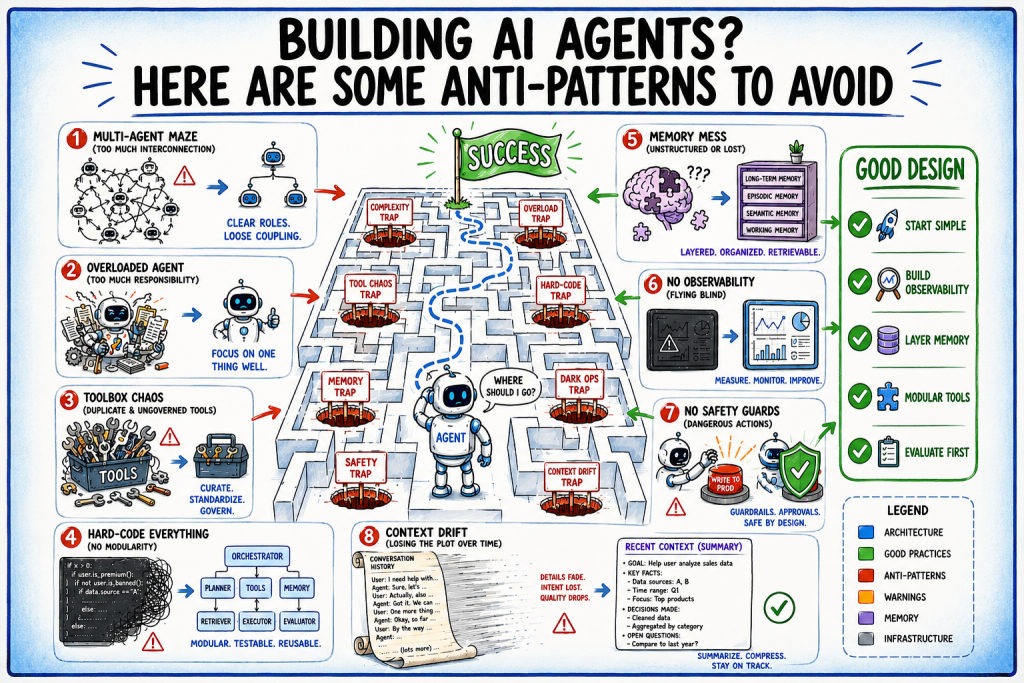
In this article, you will learn the architectural and operational anti-patterns that cause AI agent projects to fail, and how to avoid each one.
Topics we will cover include:
- Why agent failures compound differently than failures in simpler, single-response AI systems.
- The architectural anti-patterns — from premature multi-agent systems to tool sprawl, hardcoded logic, and missing memory design — that make agents brittle as they scale.
- The operational anti-patterns — including missing observability, ungoverned write access, context drift, and skipped evaluation — that only surface once an agent reaches production.
Introduction
AI agents fail in predictable ways. The model is rarely the problem; the architecture, the memory design, the tooling decisions, and the way complexity gets introduced are where things go wrong. Most failed agent projects share a handful of structural mistakes that only become visible later, when they’re expensive to fix.
Understanding what breaks AI agents — and why — gives you a better mental model for what working agents actually require. An effective approach is to start simple, build for observability, and add complexity only when you can measure the return. The anti-patterns are what happens when teams do the opposite.
This article covers:
- Why agents fail differently from simpler AI systems
- The architectural mistakes that compound as your system grows
- The operational mistakes that only surface in production
- A summary table mapping every anti-pattern to its fix
Start here before you start building.
Why Agent Failures Hit Harder
A language model answers a question. An agentic system solves a task: assessing what to do, choosing tools, acting on results, adjusting when something goes wrong. The reasoning loop is what makes agents powerful, and it’s also what makes them fail in ways that a prompt-and-response system never would.
When a chatbot gives a bad answer, the conversation ends. When an agent goes wrong mid-task, however, it keeps going. It might call tools with bad parameters, produce outputs that downstream steps depend on, or loop indefinitely because it can’t recognize that it’s stuck. The blast radius of a bad decision grows with every step.
Autonomous agents also accumulate state across steps, which means errors compound. An incorrect tool call in step two affects the context available in step five. A stale memory entry shapes decisions three steps later. By the time something looks wrong to the user, the agent may have already taken several incorrect actions based on a faulty initial assumption. This is why agent failures are different in kind, not just degree.
Reaching for Multi-Agent Architecture Too Soon
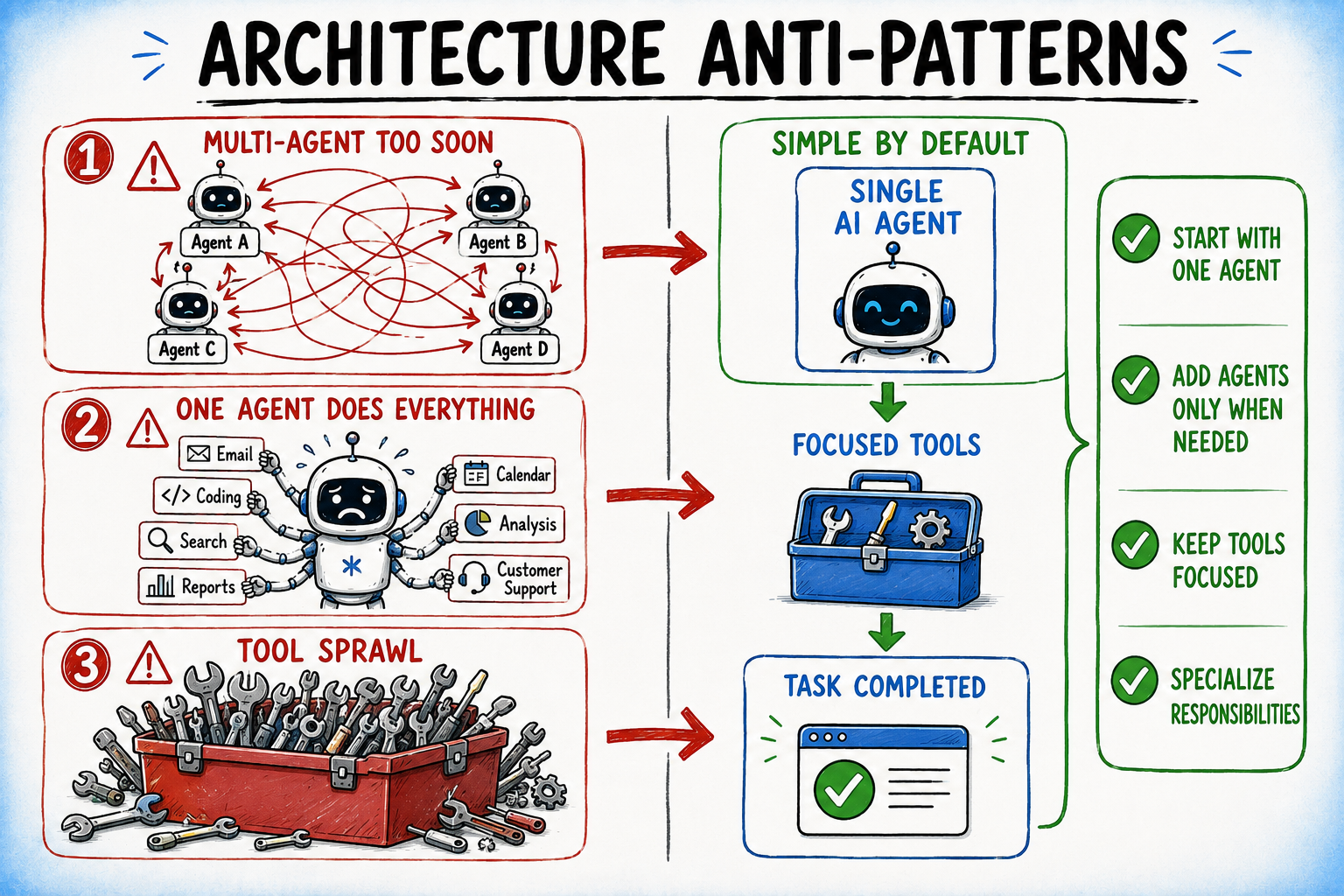
The most common architectural mistake is treating sophistication as a goal. Teams read about multi-agent systems, hierarchical orchestrators, and peer-to-peer collaboration, and design toward those patterns before they’ve validated whether a single agent can solve the problem.
Multi-agent systems introduce coordination overhead that compounds cost and debugging difficulty in ways that are hard to anticipate upfront. A few questions worth asking before you go multi-agent:
- Can a single agent with well-designed tools already solve the problem?
- Have you measured where the single-agent approach actually breaks down?
- Does the business value justify the token cost and added complexity?
Usually, for a first deployment, a single agent does the job. Start with the simplest thing that could work, measure it, and add layers only when the data shows you need them.
Building One Agent That Does Everything
A single agent configured with fifteen tools, sprawling instructions, and responsibility for wildly different task types will underperform across all of them. Optimizing for one kind of input hurts performance on others, which is why routing inputs to specialized agents — rather than one general-purpose one — tends to produce better results.
The fix isn’t always to add more agents. Often a well-scoped single agent with specialized skills outperforms a bloated general-purpose one. Narrow the responsibility first. If that still isn’t enough, then you have a real case for splitting.
Letting the Tool List Sprawl
Every tool added to an agent’s context is a tool the model has to reason about when deciding what to do next. A large tool surface increases the chance of the model choosing poorly, inflates prompt size, and makes debugging harder because there are more possible paths through any given task. Too many tools, or tools with overlapping purposes, actively distract agents from pursuing efficient strategies.
Keep the tool set minimal and purpose-specific:
- Tools should be discrete, reusable modules with clear, non-overlapping responsibilities
- If tools share similar functions, namespace them explicitly so the model can distinguish them
- If you’re adding tools to handle edge cases, that’s a signal the task scope needs to shrink — not that the tool list needs to grow
AI agent architecture anti-patterns
Hardcoding Logic Instead of Building for Change
Agent systems change constantly in production. A prompt that works today gets revised next week as tools get refactored and model updates shift what’s possible. When an agent’s logic is hardcoded into a monolithic implementation rather than composed from separable components, every one of those changes risks breaking something else.
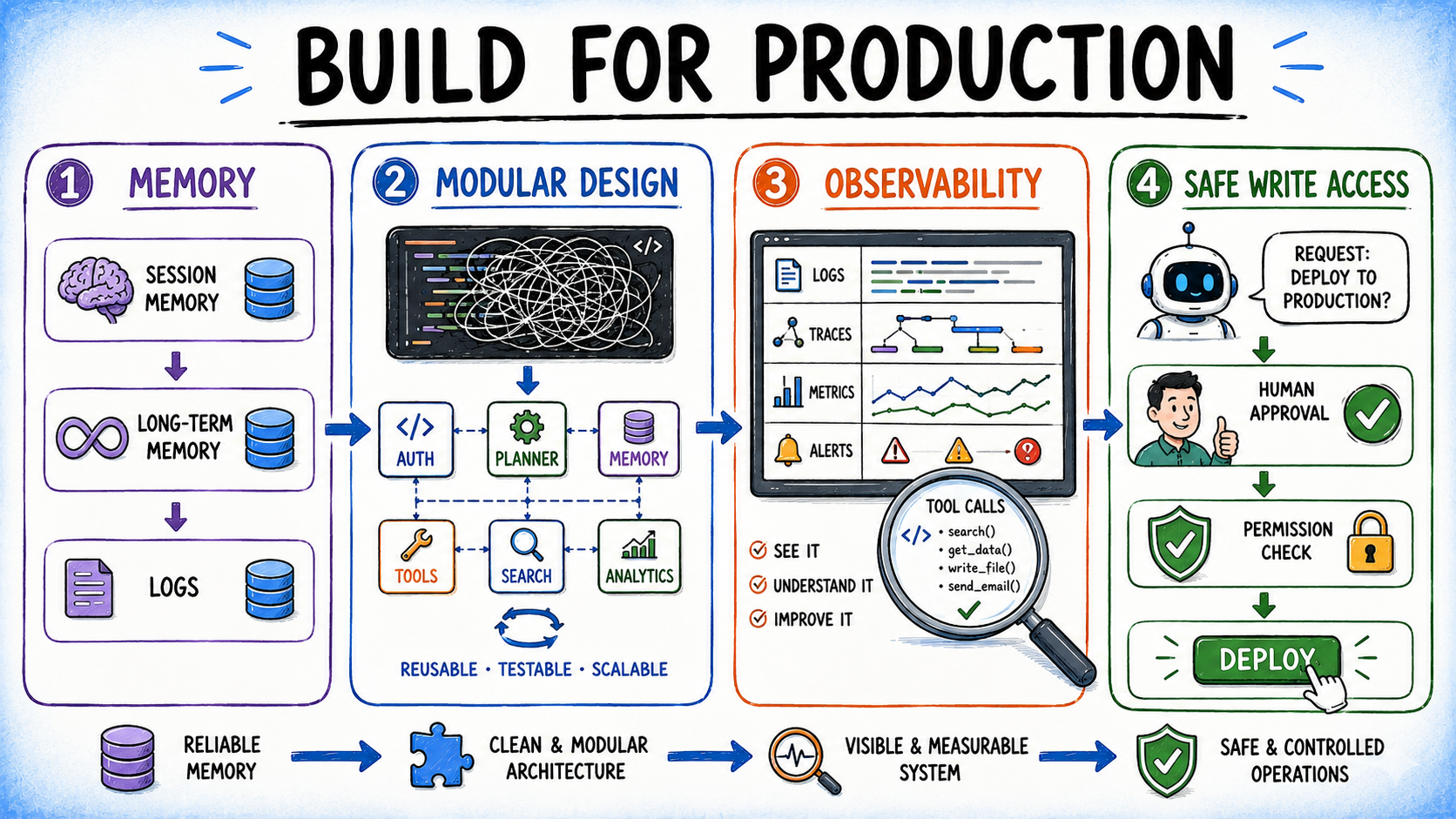
Modular design means prompts in centralized configuration, tools as discrete units, and agents assembled from only the components they need for a given task.
Skipping Dedicated Memory Design
Many teams design agents the same way they design chatbots: pass the conversation in, get a response out. An agent working a multi-step task needs to know what it did two steps ago, whether a tool call succeeded, and what intermediate results it’s carrying forward. Without a deliberate memory design, context window overflow becomes a production incident rather than a design consideration.
A layered approach handles this cleanly:
- Short-term session memory for current task state and recent tool outputs
- Long-term memory (typically a vector store) for cross-session context and learned patterns
- Structured logs for auditability and debugging
Build this in from the start. Retrofitting a memory architecture onto a deployed agent is genuinely painful and usually results in a partial rebuild anyway.
Shipping Without Observability
AI agents are usually non-deterministic systems with opaque reasoning processes. When something goes wrong, you can’t look at a stack trace and understand why the agent made a particular decision. You need visibility into the prompt chain, the tool calls and their parameters, the model’s reasoning path, and how context flowed through multi-step execution.
Teams that ship without observability in place will likely spend weeks debugging issues they could have diagnosed in minutes with proper instrumentation. This is especially true for multi-agent systems, where a failure in one agent’s output can cascade through several downstream agents before producing a visible symptom. Build observability in from the first line of code.
Giving Agents Ungoverned Write Access
LLMs can hallucinate, reason incorrectly, and produce wrong answers with high confidence. An agent with direct write access to production systems — or the ability to send communications to real users — needs guardrails between its outputs and those actions. Read operations and write operations are different risk categories and should be treated as such from the start.
In practice this means:
- Output validation before any write operation executes
- Scope constraints that limit what the agent can touch
- Human-in-the-loop confirmation for high-stakes or irreversible actions
Design your agent’s permission boundaries to reflect the actual risk associated with each tool rather than granting broad access by default.
Agent design practices to follow
Ignoring Context Drift in Long-Running Tasks
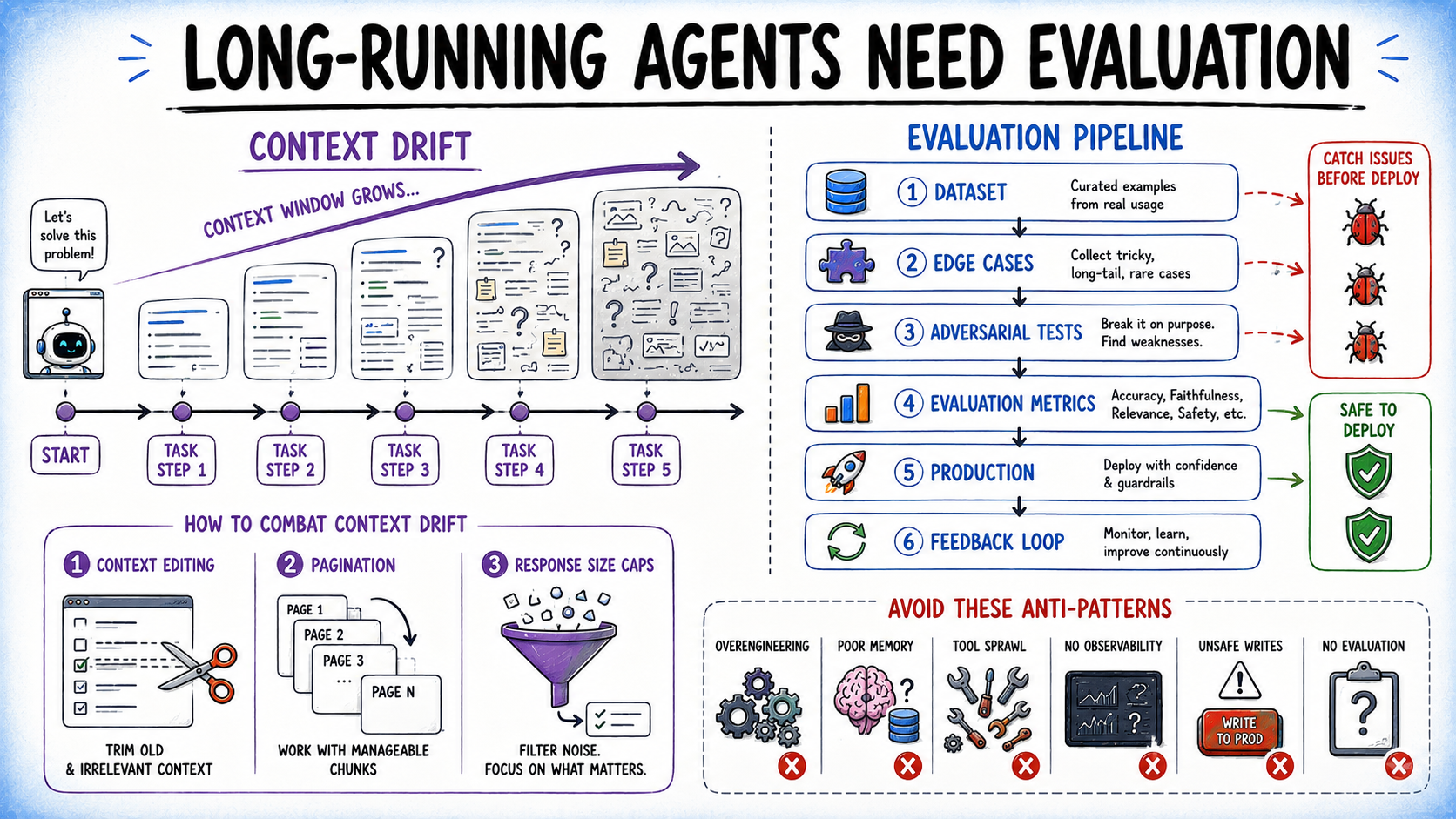
Context that was accurate when the agent started a task degrades as the task runs. Data changes and tool outputs from early steps go stale. This effect, known as context rot, refers to a model’s declining ability to accurately recall information as the number of tokens in its context window grows.
Context window, therefore, has to be treated as a finite resource with diminishing returns, not a bucket you keep filling up. For long-running agents, this is often a normal operating condition.
Practical mitigations include:
- Automatically clearing stale tool results when approaching token limits while preserving conversation flow
- Pulling only what the agent needs from tool responses rather than dumping full datasets into context
- Enforcing a ceiling on tool output size so one large result can’t crowd out everything else
Don’t wait for the agent to start hallucinating before you address this.
Handling context drift
Deploying Before You’ve Actually Evaluated
Agents that work in a controlled test environment expose new failure modes in production. Testing against a fixed set of happy-path examples is only confirmation that the agent handles the cases you already thought of.
Effective agent evaluation means running the agent against diverse, adversarial, and edge-case inputs before deployment, defining success metrics that connect to business outcomes rather than internal model performance, and having a feedback loop in place so production failures directly inform the next iteration.
Summary
Agent failures are more often architectural than model failures, with avoidable mistakes like over-engineering, overloaded agents, missing memory, poor observability, and ungoverned tool access causing projects to stall. Here’s an overview of the anti-patterns we’ve discussed and the suggested fixes for each:
| Antipattern | The Fix |
|---|---|
| Multi-agent architecture too soon | Start with a single agent; add agents only when measured data justifies it. |
| One agent doing everything | Narrow scope first; specialize before you scale. |
| Tool list sprawl | Keep tools minimal, non-overlapping, and purpose-specific. |
| Hardcoded monolithic logic | Keep prompts in configuration, tools as discrete units, and compose agents from reusable components. |
| No memory architecture | Build layered memory (session, long-term, and logs) from day one. |
| No observability | Add structured logging and distributed tracing before you ship. |
| Ungoverned write access | Separate read/write permissions, add guardrails, and require human confirmation for high-stakes actions. |
| Context drift in long tasks | Use context editing, response pagination, and output size caps. |
| Deploying without evaluating | Test adversarial and edge-case inputs, and tie success metrics to business outcomes. |
And here are some resources are worth your time:
Happy building!