




Editor’s note: This article was first published in Global Atlanta, an online news publication devoted to revealing the city’s ties with the world and helping local companies navigate the global economy.
ATLANTA, June 11 (Global Atlanta) – To say that traffic will spike during matches anticipated in FIFA World Cup host cities across North America is an understatement.
But some cities may be better suited to handle it than others, according to Geotab, a Canada-based telematics platform that tracks real-world telematics data from commercial vehicles, helping fleet operators improve management, save fuel and get ahead of maintenance issues.
While Geotab celebrated 25 years in 2025, the Toronto-area company isn’t resting; it’s building on the massive trove of data collected from 6 million vehicles on behalf of more than 50,000 customers, anonymizing it and putting it to work for urban planners, city leaders and economic developers.
The Altitude platform, launched in 2021, helps stakeholders see how commercial vehicles are moving around their regions, adding an “intelligence layer” to their planning processes, said Nate Veeh, associate vice president for business development.
Fleets working with Geotab get one of its GO devices installed directly into their onboard computer (some also get the GOfocus camera), which gives a real-time view of “thousands of signals,” from speed to travel times to harsh braking data.
“Basically the brains of the vehicle itself and how it’s being operated, we collect all that, and we build tools to make it easy to consume,” Mr. Veeh told Global Atlanta.
After many years of healthy data collection, the company realized it had a hugely valuable byproduct from all that fixed infrastructure.
“We thought, ‘We have access to all this underlying data, why don’t we build an intelligence layer to provide insights to a new type of audience,” Mr. Veeh added.
World Cup Traffic and Real-World Impact
It’s Altitude that gives the company confidence in ranking of how World Cup host cities’ freight networks will hold up around the stadiums on match days. Atlanta’s Mercedes-Benz Stadium, according to the study, could be set to struggle, ranking No. 12 out of 16. Its Achilles’ heel was a metric called “resilience,” which measured the lingering effects of match-day traffic on the stadium area as well as on the broader metro against a normal day.
The World Cup rankings may be a novelty, but Mr. Veeh said that Geotab’s data, increasingly amplified with the use of artificial intelligence, has real-world implications for safety and sustainability.
Altitude data can help planners identify blindspots proactively. There may be an intersection, for instance, where hard braking indicates a problem even though near-misses don’t show up in after-the-fact accident statistics. Interventions in such cases can save lives, not to mention collision damages.
On the sustainability front, Geotab helps individual fleet managers better track fuel efficiency and meet climate goals, but at the aggregate level, it can inform decarbonization efforts at the infrastructure level.
Altitude offers governments the Regional Domicile Analysis tool, tracking real-world usage of trucks, buses, delivery vans and other fleets to evaluate whether they’re suited for electrification — and what investments might be needed to make that happen.

Building in Atlanta: From Pilots to Partners
With its vast interstates and sprawling metro road networks, Atlanta is a prime proving ground for Geotab’s solutions. Altitude has partnered with The Ray, the living laboratory for mobility innovation along Interstate 85. Corridor data collected there is informing national decisions on where to place charging stations for electrified semi-trucks and other vehicles.
Geotab also conducted an analysis evaluating why trucks are parking on on- and off-ramps along interstate highways. A blend of regulated mandates for driver rest periods and a shortage in truck parking has given rise to the issue, with Atlanta among the cities facing it most acutely.
Organizations like the Atlanta Regional Commission, the City of Atlanta and even neighborhood planning units have come together on project-based Geotab subscriptions, with some moving into longer-term deals with the company.
“We’re not going to answer everything for them, but we can be a good layer when they start the conversation,” Mr. Veeh said.
But perhaps the most impactful Atlanta connection is the Geotab office in the shadow of Ponce City Market.
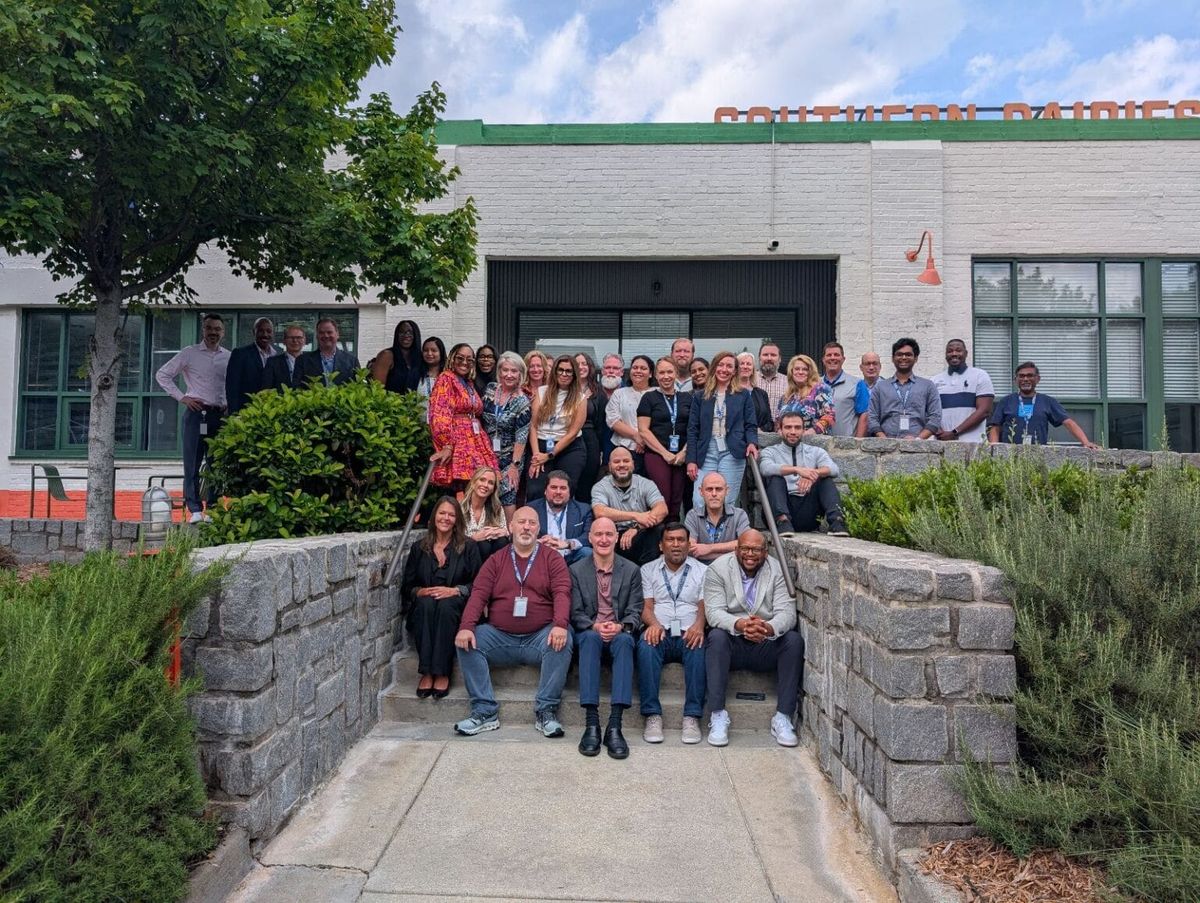
The U.S. headquarters at Southern Dairies has provided access to a steady stream of talent coming out of Georgia’s universities, with an emphasis on engineers that can help transform more than 100 million data points a day into usable intelligence.
Along those lines, Geotab last year donated $223,000 to Georgia Tech to support research by doctoral students into traffic data and road safety, working alongside Geotab staff.
“We are driven by innovative research,” said Neil Cawse, founder and CEO of Geotab, said at the time, continuing:
“Geotab is marking its 25th anniversary, celebrating remarkable global growth, pioneering AI driven innovation, and continuing to support research in the communities we serve. Georgia Tech is a key community partner that is helping us improve a real-world problem — traffic congestion — by embedding researchers on our teams where they can learn and contribute alongside one another.”
While in Atlanta for that announcement, Mr. Cawse joined Georgia Department of Transportation officials, professors and other Geotab execs to speak to students in the university’s Supply Chain Logistics Institute under the topic: Data Driven: From Start-Up to Global Leader – A Founder’s Perspective
The company also donated $25,000 to the United Way of Atlanta in honor of long-time client Rollins Inc., the pest-control giant based in Atlanta that began working with Geotab two decades. Rollins received the CEO Visionary Award from Mr. Cawse at a Sept. 9 event.