




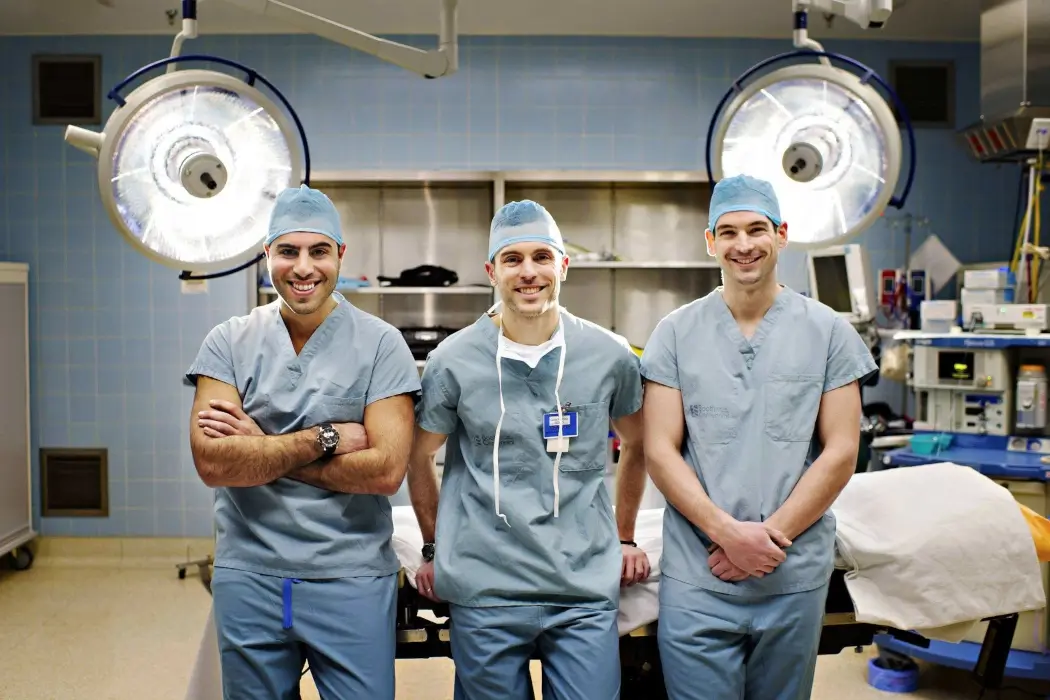
The Waterloo company expected to sell. Sixteen years later, it is building to stay.
Many medical device startups build with an eventual buyer in mind.
Typically, these startups develop a technology and prove its clinical efficacy before selling to a larger company with the distribution muscle to take it further. The co-founders of Intellijoint Surgical initially expected to follow that path.
“We are not doing this simply to make other people wealthy. We are doing it to create value for ourselves, our community, and the stakeholders around us.”
Andre Hladio,
Intellijoint
“We thought that within eight months we were all going to be millionaires and would figure out life from there,” said Intellijoint co-founder and chief technology officer Andre Hladio. “That was 16 years ago.”
The Kitchener-Waterloo-based company started as a fourth-year capstone project within the University of Waterloo’s mechatronics engineering program. Armen Bakirtzian, Richard Fanson, and Hladio had set out to solve a problem that existed inside many operating rooms: surgeons performing joint replacements needed better tools to help them align implants accurately during surgery.
After graduating, the trio founded Intellijoint in 2010, with Bakirtzian as CEO, Fanson as chief science officer, and Hladio as CTO. They worked closely with orthopedic surgeons to turn the student project into a medical device company. The first product, Intellijoint HIP, received its Health Canada Device Medical Licence in 2013 and was used for the first time at Mount Sinai Hospital in Toronto that same year.
Intellijoint has since expanded into pre-operative surgical planning and intraoperative surgical navigation for hip and knee replacements.
The founders’ early work repeatedly put them inside operating rooms alongside the surgeons using the technology. Hladio said some of the earliest evidence that the company had built something meaningful came from seeing its effect during live procedures.
“There have been times when we thought ‘oh no, this is not going well,’ for one reason or another,” Hladio said. “But over time, we started seeing surgeries where, without our product, the surgeon would have made a different decision that could have been detrimental to the patient. That is when we started to understand that we were going to gain traction.”
He explained that Intellijoint built its products around efficiency, affordability, and usability rather than developing a sprawling surgical system, adding that the company’s Canadian roots shaped that focus from the very beginning.
“We live in a system with a rationed healthcare model, particularly for elective surgery,” Hladio said. “As a result, the need for efficiency is very apparent. If that need for efficiency is ingrained in you, I think you can create very efficient solutions.”

The nature of Canada’s healthcare system also created some challenges for Intellijoint early on. Hardware startups face longer development cycles and have higher capital needs compared to their software counterparts. For medical devices, those challenges are compounded by tough procurement cycles and rigorous regulatory demands.
“You need funding to make a product, but you need a product to get funding. Throughout our lifecycle, we have continually faced that kind of chicken-and-egg scenario,” Hladio said.
One solution to that problem was to get far enough to attract a strategic buyer. But an early investor in Intellijoint helped convince the founders that building for the long term was possible. Over time, they revised their assumption that acquisition had to be the destination. For Hladio, independence has come to mean retaining autonomy over the product, preserving equity, and continuing to build talent and expertise in its founding country.
“We are not doing this simply to make other people wealthy,” Hladio added. “We are doing it to create value for ourselves, our community, and the stakeholders around us—the people who made all of this possible. There have been a lot of taxpayer dollars invested in our education and in the social supports that we have all benefited from, and maintaining independence gives us an opportunity to pay that forward.”
Large medtech companies have sales channels that allow them to build relationships with hospitals, push numerous products through the same networks, and create a defensive moat, Hladio explained. By choosing to hold onto control, Intellijoint had to build those capabilities itself.
“The biggest difference for us has been developing the right competencies and making the right investments in our channels so that we can run a business for profitability rather than for acquisition,” Hladio added.
Investors have become an important part of that equation. Graphite Ventures, in particular, has helped the company balance its ambitions around Canadian ownership and global growth with the financial realities of building a larger business. Graphite invested in 2025, though the relationship stretches back to 2013 when Graphite’s predecessor, the MaRS Investment Accelerator Fund, led a $3.3-million Series A funding round in the company.
“Having an investor like Graphite helps us think through the entire corporate development lifecycle in a realistic way,” Hladio said. “That provides an important filter as we continue to pursue our core values while also building a sustainable growth strategy.”
Choosing to stay independent has also started to widen Intellijoint’s ambitions. Through IJX, a relatively new division, the company has begun commercializing its surgical navigation technology and expertise through partnerships beyond hip and knee reconstruction and into adjacent surgical markets.
“We thought that within eight months we were all going to be millionaires and would figure out life from there. That was 16 years ago.”
IJX allows other medical device companies to integrate Intellijoint’s underlying enabling technology with their products. Partners can take the technology off the shelf, integrate it through APIs and evaluation systems, or work with IJX on more bespoke products. IJX has successfully supported more than 90,000 surgical cases worldwide across a variety of orthopaedic procedures.
Hladio said IJX is part and parcel of its decision to build rather than sell, since independence creates a reason to diversify.
“As an early investor, we’ve seen Intellijoint grow steadily with their core HIP and KNEE surgical products, building a very loyal customer base with sales in many countries,” said Aaron Bast, Managing Director of Graphite Ventures. “The introduction of the IJX strategy has created even larger upside potential, a path that would have been much more difficult as part of a larger organization.”
“The decision to stay independent and grow from their base in Canada has allowed Intellijoint to be more innovative and create a world-leading orthopedic medtech company,” Bast added. “At Graphite, we only invest in Canadian companies, and Intellijoint is the perfect example of how great Canadian talent can build and grow here in Canada.”
Intellijoint’s diversification is happening as its core business pushes further abroad. The company still conducts most of its business in Canada and the United States, but Hladio said it is seeing growing adoption in Latin America and Asia, while expanding its network of surgeons and building broader brand recognition.
At the same time, the company has also invested in the ecosystem around it. The company helped establish the Medical Innovation Exchange, a Waterloo Region hub aimed at helping Canadian and healthtech companies grow and stay in the country.
The next phase for Intellijoint is proving it can grow into a durable global business on its own terms. It is a long way from the founders’ original expectation of building toward a buyout. Now, their priorities are keeping control and building new lines of business around its core technology, all the while keeping the company firmly rooted in Canada.
PRESENTED BY

Check out Scale Canadian for more stories of those building in Canada and scaling globally.
Feature image courtesy Intellijoint.