




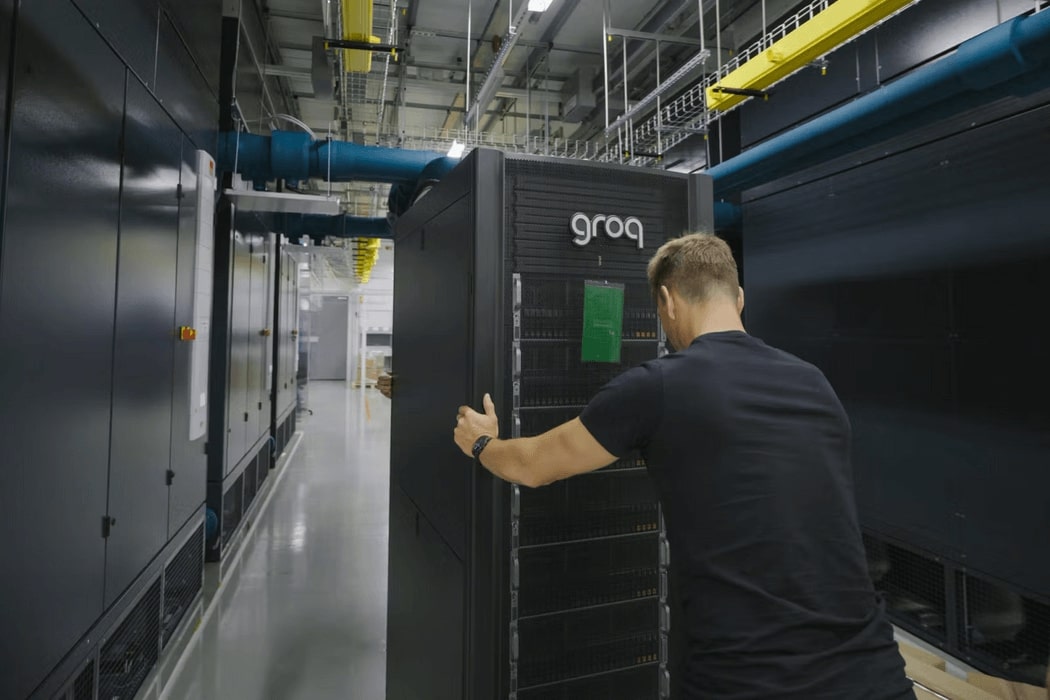
Garage Capital and Chamath Palihapitiya were early Groq backers.
Over the holidays, Nvidia came calling for AI infrastructure startup Groq to the tune of a reported $20 billion USD. Several Canadian investors who backed the San Jose, Calif.-based startup are poised to cash out, big-time.
The eye-watering deal, which Groq framed as a non-exclusive licensing partnership, brings key Groq executives over to Nvidia and licenses its intellectual property to the larger chip company. Groq will remain an independent company, it said in a statement.
“We’re just excited to have been such a part of this journey of seeing Groq from the ground level.”
Mike McCauley
Garage Capital
Critics have suggested the deal could be an attempt to avoid antitrust regulators’ scrutiny, with analyst firm Hedgeye Risk Management calling it “essentially an acquisition.” Nvidia, which briefly crossed $5 trillion USD in market capitalization this year, holds the majority of market share for its AI chips, compared to competitors AMD and Intel. This year, Nvidia has made investments into other AI giants, including Anthropic and OpenAI, which continue to buy Nvidia hardware to build more data centres to increase compute capacity.
Canadian-American venture capital investor Chamath Palihapitiya is poised to cash out significantly on this deal, as his firm Social Capital led Groq’s $10-million USD Series A round in 2017, then participated in Groq’s $60-million USD fundraise in 2018, reported by TechCrunch at the time. Palihapitiya also sat on Groq’s board until 2021.
In a post on X on Dec. 24, Palihapitiya shared his investment memo from 2016, in which he sketched out the argument for backing Groq at a $25-million USD pre-money valuation.
“There is an opportunity to build a new stack that allows a broad ecosystem of machine learning to power most software applications,” the investment memo reads.
Kitchener-Waterloo-based Garage Capital was the other Canadian investor that joined the $10-million USD investment in 2017. Managed by Waterloo grads and Vidyard co-founders Michael Litt, Mike McCauley, and Devon Galloway, Garage Capital is a pre-seed and seed firm investing in a range of industries, from AI inference to defence tech. Garage Capital is currently investing out of its most recent fund, which closed early this year, McCauley said.
McCauley said in an interview with BetaKit on Monday that though he wouldn’t share Garage Capital’s exact return from the Nvidia deal, it’s a “fabulous outcome” for the VC and represents its largest dollar return investment to date.

McCauley said he met Groq founder Jonathan Ross when they worked together at Google X, its research and development division. He noticed that Google co-founder Sergey Brin would often go and chat with Ross, which tipped McCauley off to his “brilliance and insight.” McCauley said he helped Ross meet other interested investors when he founded Groq and joined the round himself.
Garage Capital’s initial cheque size was standard for its “humble garage beginnings,” McCauley said. The firm invested in Groq six times, including this year.
“We’re just excited to have been such a part of this journey of seeing Groq from the ground level, on the inside, all the way through to such a wild outcome,” McCauley said. “It’s a really cool Canadian story.”
Cambium Capital, whose managing partner Landon Downs is based in Vancouver, also backed Groq’s Series B investment.
Groq has roughly 90 Canadian employees, according to its LinkedIn page, and a large office in Toronto. There are “plenty of Canadian employees benefitting from these outcomes,” McCauley said. According to Axios, employees at Groq stand to substantially profit. Around 90 percent% of Groq employees are reportedly joining Nvidia and will be paid cash for their vested shares; remaining Groq employees will also be paid for vested shares, and all employees who are new to the company will have some shares vest immediately.
RELATED: CoLab joins Nvidia Inception Program to beef up AI capabilities for its engineering tools
This type of “acqui-hire”-style deal has grown increasingly common in the AI space, with a larger company taking key talent and IP but leaving the remaining startup intact. In contrast to the Groq deal, some of these deals have left non-acquired employees with very little: Google’s last-minute purchase of a portion of AI coding assistant Windsurf stripped the company of its key talent and left the remaining employees without meaningful compensation (until Cognition bought it shortly after).
Canadian talent is also high up in Groq’s ranks. University of Waterloo graduate Adrian Mendes served as Groq’s chief operating officer from 2018 to 2023. Sunny Madra, Groq’s president, who is joining Nvidia as its vice-president of hardware, graduated from the University of Ottawa. Madra later founded Extreme Venture Partners, where he was embroiled in a legal battle alongside Palihapitiya for breaching contractual obligations and conspiring to acquire startup Xtreme Labs at a discounted price.
Founded in 2016 by Google engineers, Groq develops hardware designed for large-language models (LLMs) to run computations, called language processing units (LPUs). The company was last valued at $6.9 billion USD in September and was targeting $500 million USD in revenue this year, according to CNBC. The company is a separate entity from Elon Musk-owned AI chatbot Grok, as Groq has publicly noted.
Groq was also active in Canadian AI supply chains. In May, it struck a deal with telco Bell to provide the chips and inference technology for a planned buildout of six AI data centres in British Columbia.
Nvidia, the world’s most valuable company, which crossed the $5 trillion USD this year, has increasingly been amassing dominance in the AI market with its graphics processing units (GPUs) chips that are used in most AI supply chains, including many in Canada. It scooped up Canadian AI efficiency startup CentML in June for an undisclosed amount, after backing its seed round. The company has also partnered with Canadian telco Telus, and a large portion of a recent federal investment in the University of Toronto will go toward buying Nvidia chips.
Feature image courtesy Michael Litt via LinkedIn.