




Follow ZDNET: Add us as a preferred source on Google.
As an iPhone owner, I primarily use Siri through CarPlay when I’m driving. Apple’s voice assistant can handle basic tasks like giving me turn-by-turn directions, making phone calls, sending texts, checking my calendar, creating reminders, and playing music and podcasts. For more challenging questions that stump Siri, I’ve been turning to ChatGPT.
But since my Toyota Camry supports Android Auto as well, I wanted to see how Google Gemini would fare as my in-car assistant. With that in mind, I’ve been using Gemini with my Android phone when I’m behind the wheel. I’ve given it a variety of tasks to perform and questions to answer.
Also: Does Android Auto make your phone overheat? Try these 8 ways to cool it down
With Google’s AI, you can send emails and messages, ask for playlist suggestions, get information on local restaurants and businesses via Google Maps, set reminders, ask any question on your mind, play a game, listen to a story, and more.
How did Gemini perform in my experience? You’ll have to read on to find out. But here’s how I’ve been using Gemini and how you can, as well.
To rev up Gemini through Android Auto, you need an Android phone and a car that supports Android Auto. Check Google’s “Find your ride with Android Auto” page to see if your car’s stereo or multimedia system is compatible. If you have the right phone and car, let’s go through the initial steps.
The process is different on Samsung phones. Here, head to Settings, select Apps, and tap the option to choose default apps. Tap the entry for Digital Assistant app and make sure it says Google. If not, tap the entry on the next screen and change the selection to Google. To confirm that Gemini is the default on your Samsung phone, hold down the power button. A window should pop up telling you that Gemini is your new AI assistant from Google.
To use Gemini in your car, you want to be able to activate it hands-free. For this, open the Gemini app on your phone, tap your profile icon, and select Settings. Tap the option to talk to Gemini hands-free, and then turn on the switch for “Hey Google.” Tap the Turn on button and then tap Done.
Next, connect your Android phone to your car. You can do this through a wired USB cable or a wireless Bluetooth connection. For a wired connection, you need Android 9 or higher; for a wireless one, you need Android 11 or higher.
After connecting your phone, go back to the Android Auto settings on your device and tap the “Connect a vehicle” button. If your phone is plugged in via USB, the connection is automatically established. If you’re going the wireless route, choose the option to connect using wireless Android Auto, and then opt to connect using Bluetooth.
On your car’s multimedia screen, go to Settings, select “Bluetooth and devices,” tap the button to add another device, and then tap the button to search for devices. Select the name of your phone on your car’s screen after it pops up. The same pairing code appears on your phone and the car screen. Confirm the code on both devices.
On the car screen, tap Yes when asked if you want to use Android Auto. You should then see the Android Auto interface on your screen.
Gemini is still rolling out as a voice assistant for Android Auto, so the AI isn’t yet accessible to everyone. To check when you’re in your car and Android Auto is active, say: “Hey Google. Are you using Gemini?” If the assistant doesn’t understand your request, then you’re still stuck with the older Google Assistant. But if it proclaims that it’s using Gemini, then you’re good to go.
Also: My 4 favorite Android Auto settings are seriously useful – but hidden by default
You’re now ready to chat with Gemini. To take the AI for a spin, just say: “Hey, Google” to activate it and tell it what you want. Now, here are some of the tasks I gave it and how it performed.
First up, I was hungry for one of my favorite foods — sushi. I asked Gemini to find some nearby Japanese sushi restaurants. The AI pulled up a list of nearby spots. One restaurant in particular interested me, so I asked for more information about it. Gemini then asked if I wanted to go there, at which point it served up driving directions via Google Maps.
I needed to contact someone while I was driving but didn’t want to fiddle with a phone call. Instead, I told Gemini to send that person a text. The AI asked me for the subject, which I supplied. The text went on its merry way.
As a huge Spider-Man fan, I’ve been keen to watch the new “Spider-Noir” series on Amazon Prime and was curious about its initial reception. I asked Gemini to give me the latest reviews of the show. The AI provided a general overview and read a few specific reviews for me.
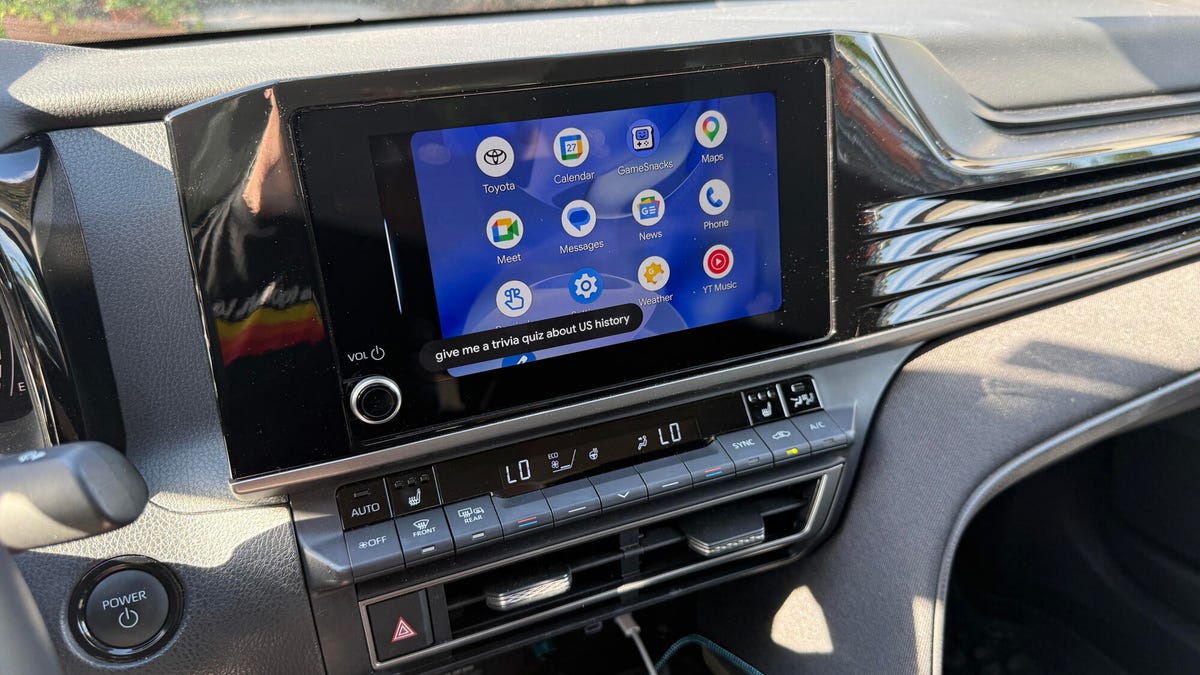
To pass the time while driving, I typically listen to music or podcasts. But sometimes I want something more interactive. Here, I asked Gemini to play a game. The AI tuned up a trivia game about US history. At first, the questions were too simple. But I told Gemini to give me more of a challenge, and it did the trick.
Finally, a good conversation is another way to stay engaged during a lengthy car ride. Here, I asked Gemini to start a stimulating conversation. It returned to the topic of Mr. Giggles speaking, and we discussed what he might say about his favorite foods, his least favorite household item (the robot vacuum), and other things around the house.
In the end, I liked the ease and effectiveness of chatting with Gemini in the car. Compared with having to use both Siri and ChatGPT with my iPhone, Gemini is more of a one-stop shop, helping me with everything from basic commands to more complex and interactive tasks. From now on, I’ll be sure to take my Android phone with me when I drive so I can call on Gemini whenever I want.