




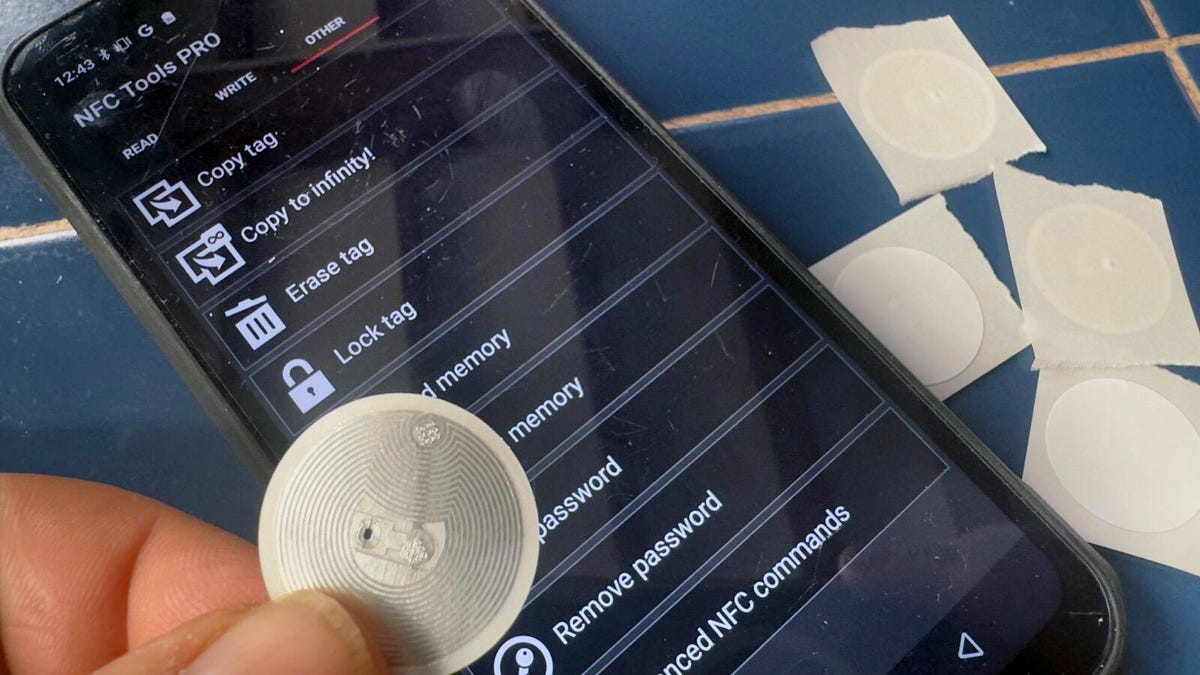
Writing NFC tags with a smartphone.
Adrian Kingsley-Hughes/ZDNET
Follow ZDNET: Add us as a preferred source on Google.
One of my favorite technologies is NFC. I’m blown away that I can write data to a little chip and then access that using a phone or tablet. I’ve embedded NFC tags into all sorts of things, from documents to business cards to 3D-printed objects.
And it’s easy!
What you’ll need
You need two things:
- NFC tags: These come in all sorts of shapes and sizes, from stickers to keychain disks to plastic cards. I go for NTAG215 compatible tags, because they are widely available, cheap, have enough on-board memory for my needs (504 bytes ought to be enough for anybody), and they have a data-retention lifespan of at least 10 years or 100,000 writing/rewriting cycles. You can find NTAG213 NFC tags that are cheaper, but these are limited to 137 bytes, and I’ve had website URLs that exceed this length.
- NFC reader/writer app: I use NFC Tools, available on both iOS and Android.
The NTAG215 stickers are cheap and perfect for disposable applications.
Adrian Kingsley-Hughes/ZDNET
How to create an NFC tag
Writing a few dozen tags with a smartphone app is fine, but if you find yourself wanting to write a lot, you’re moving into the realm of an industrial setup like the Sato CT4-LX.
Also: I found AirTag alternatives that are tough, loud, and compatible with Android phones
You have the tags, the app is installed, and you’re ready to write your first tag. To write a tag that opens a webpage, tap Write, then Add a record, tap URL/URI, enter the address of the web page you want to open in the box, and tap OK.
NFC Tools app is packed with features.
Adrian Kingsley-Hughes/ZDNET
Now, to write to the tag: tap Write, then bring the tag to the back of the smartphone. It should detect the tag and write the data to it. It’s that easy!
How to test your NFC tag
To test the tag, exit the app, bring the tag up to the back of the smartphone, and it should be picked up and prompt you to go to the web page.
Also: Finally, Bluetooth trackers for Android users that function even better than AirTags
But you’re not done. Remember that NFC tags are rewritable, and you don’t want others fiddling with tags you’ve placed on things, as this could be a big security issue.
You have two options, both available in the NFC Tools app. You can password-protect the tag or lock it.
With stickers, I tend to lock these, as it’s quicker (you don’t need to create or remember a password), but for reusable tags and cards, the password option allows for future reuse.
Password protecting a tag allows it to be re-written in the future, but prevents unauthorized tampering.
Adrian Kingsley-Hughes/ZDNET
The choice is yours, but you need to do one or the other to protect the tag from being altered.
And there you are. Done. Working with NFCs is that easy.
Pro tip: A handy way I use NFC tags
You can create an NFC tag to share your Wi-Fi password. If you want to do this, in NFC Tools, you’d add a record for Wi-Fi Network and enter your network’s details. I find this a super handy way to share the password for my guest Wi-Fi.
Also: How to find out if an AirTag is tracking you – and what to do about it
Experiment with what the app offers; there’s a lot in there.