




Stay up to date with Hypepotamus
Add us as a preferred source in Google
It’s been a rough year for young coders. Fresh computer science graduates are facing unemployment rates that more than double those of biology and even art history majors, according to a recent Federal Reserve Bank of New York study, with AI and automation often pointed to as the culprit.
So what should kids today be learning about tech and coding? Code Ninjas, headquartered in Georgia and operating more than 350 locations across five countries, thinks it has an answer….and it’s not memorizing syntax.
“We want kids to be ready to adapt to technology,” said Edward Kim, a Georgia Tech graduate who serves as VP of Education and Training at Code Ninjas. “We don’t know where AI is going to go. But our job is to make sure kids understand how to identify problems and build things — no matter what the tools look like.”
What Actually Happens Inside a Code Ninjas Location
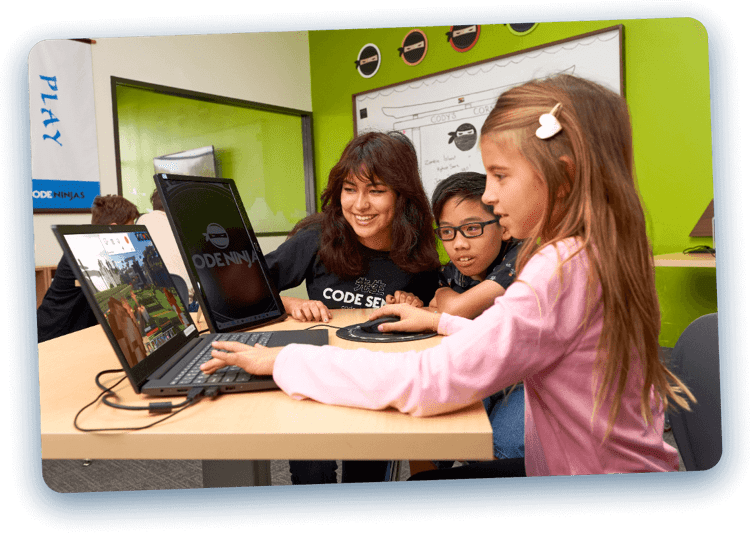
Walk into a Code Ninjas center and you won’t find rows of kids passively watching instructors type. Students, ages 5 to 14, work at individual workstations guided by “Senseis” (Code Ninjas’ term for its instructors) toward a defined end goal. Kids produce a take-home artifact at the end of every session, be it a game, a robotics project, or AI exercise.
The curriculum spans 2D and 3D game-building, robotics, and AI tools, delivered through year-round programming, semester-long clubs, and summer camps. It is not just about teaching kids one coding language. Kim told Hypepotamus that the goal is to teach kids to “identify problems to solve.”
One of Code Ninjas’ most popular summer programs is built around Minecraft, a popular video game.
“Every kid comes in knowing how to play Minecraft,” Kim explained. “But they don’t understand the deeper aspects.” Inside a Code Ninja’s class, a kid might learn how to code a calculator or rail system inside the game.
“It’s about saying, hey, the YouTubers you watch, the pro gamers — these are the things they’re doing as game editors and game creators. And we’re teaching you how to do that,” Kim added.
AI Literacy, Not AI Hype
For Kim, it is not about teaching kids specific AI tools.
“We don’t know where AI is going to go,” he said. Instead, Code Ninjas’ AI Academy program is built around durable practices, be it how to evaluate a model’s output, when to use AI versus when not to, and how to spot mistakes in a response. The curriculum actively discourages over-reliance on any single tool. Students are taught to run the same prompt through multiple large language models and compare results. It is about building critical thinking skills in the AI Age.
“We teach our kids: don’t just rely on one LLM, try three, compare their responses,” Kim said. “We teach them how to improve the efficiency of their response.”

Atlanta Roots, Global Reach
Founded in 2016, Code Ninjas moved its headquarters from Houston, Texas to Peachtree Corners, Georgia in 2024. Code Ninjas was acquired by Eagle Merchant Partners in 2012, operates in a franchise model.
Today, the company has over 350 locations across the US, Canada, and the UK. It has 4,500 employees and recently became the first kids’ coding franchise to earn the ISTE Seal of Approval — a credential from the International Society for Technology in Education that provides third-party validation of curriculum quality and alignment to learning standards.
Filling a Post-COVID STEM Gap
Places like Code Ninjas have also filled a post-COVID education gap, Kim told Hypepotamus.
“What COVID did was it reset the resources for computer science,” Kim said, as supplemental STEM money was often cut. “Now we’re seeing even more schools requesting partnerships with us, because they know they have to get back into this — but they don’t have the budget for it, they don’t have time to fully train a teacher up.”
Code Ninjas’ pitch to those schools is it shows up with the staff, the curriculum, and the tech platform ready to go.
But for Kim, the most important part is about giving kids the ability to explore their curiosity around tech.
“I tell our teachers this: our job is to make sure these kids don’t come back to us,” he said. “No, that doesn’t make sense for business — but these kids shouldn’t want to come back if we did our job. They’re at home exploring this [tech] themselves.”