




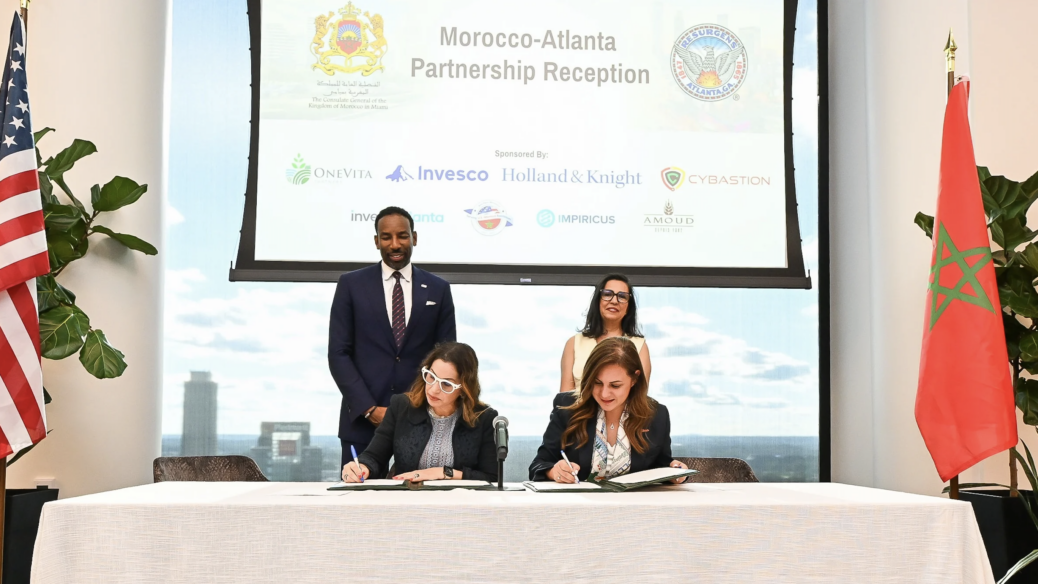
“Moroccan companies will be looking more and more to Atlanta as an option for trade, for investment, but also to learn from each other’s experiences and mutual bridges that we can create,” Ms. Khalili said, adding that Morocco’s government is dedicated to strengthening the country’s fundamentals as an international business hub.
“The country today offers a strong infrastructure, a competitive industrial ecosystem, renewable energy ambitions, very important, and also skilled African talent that could build more and more opportunities,” she added.
Atlanta Mayor Andre Dickens offered his imprimatur to the new relationship, having recently hosted the ambassador of Morocco at his office to talk World Cup connections.
Atlanta, the mayor said, is looking for “a lasting global partnership” from the World Cup, which has electrified the city.
“There’s an incredible energy in the atmosphere, and the energy goes into the stadium, it goes into our streets, and it goes all the way out into our neighborhoods, and eventually, and throughout all of that, it goes into our heart and spirit,” said the mayor, who brought many of his department heads to the event and introduced them one-by-one.
Mr. Dickens traveled to Marrakech earlier this year to witness an honor bestowed on Atlanta artist Fahamu Pecou, executive director of the African Diaspora Museum of Art of Atlanta, or ADAMA.
“We had a great time Marrakech, and we plan to go back again and again,” the mayor said. Delta Air Lines Inc. launched a flight to the Moroccan tourist hub last fall from Atlanta.
The consul general of Morocco in Miami, Chafika El Habti, congratulated the mayor on Atlanta’s World Cup campaign, pointing to the “trusted friendship” between the U.S. and Morocco that began in 1786, when Morocco became the first country to recognize the newly independent United States of America.
The relationship continues to create prosperity and opportunity to this day, she said.
“What makes the relationships exceptional is that it’s built on action. For decades, Morocco and United States have worked side by side to address common challenges, strengthen stability, expand economic opportunities and promote innovation. Our partnership is not defined by what we say, but by what we achieve together,” Ms. El Habti said.
Morocco has forged strong ties with Trump administration, signing on to Abraham Accords to normalize relations with Israel in December 2020 just as the president recognized its sovereignty over Western Sahara. That territory was annexed in 1975 by Morocco, which has occupied most of the desert landscape since it was vacated by Spain. A Sahrawi nationalist resistance movement fought Morocco until a United Nations-brokered ceasefire in 1991, and the Polisario Front continues to push for self-determination, backed by Algeria.
A potential watershed moment in the long-running conflict came last October, when the United Nations Security Council endorsed a Moroccan plan from 2007 that envisions Sahrawi autonomy under Moroccan sovereignty. The U.S., France and Spain also support the Moroccan plan. Morocco was the first country to sign on to Mr. Trump’s Board of Peace for Gaza in January, after which the U.S. convened parties for secret talks to resolve the conflict in Madrid in February. Still, progress has been halting.
The Western Sahara issue made a surprise cameo in the Atlanta forum, as Cybastion Senior Vice President Scott Blacklin talked about the Arlington, Va.-based company’s efforts to build out digital infrastructure and train tech workers in Morocco and what he called “Moroccan Sahara.”
A political settlement, Mr. Blacklin said, would open the doors for even further business growth. The mayor of the city of Dakhla, a coastal Western Sahara city where Cybastion is proposing a data center and artificial intelligence facility, was supposed to have been in the audience but missed the event due to a prior engagement.
The signing was held at the global headquarters of Invesco, whose CEO, Andrew Schlossberg, opened the venue as a favor to Mr. Dickens. Mr. Schlossberg chairs the Atlanta Committee for Progress, a public-private partnership with a board comprised of executives from Atlanta’s top companies.
He endorsed the city, where it was founded 50 years ago, as a fitting place for a company that does business in more than 100 countries and manages more than $2.5 trillion in assets.
“Our global headquarters remains here, and that foundation really matters to us at Invesco,” Mr. Schlossberg said, later adding: “The city has always been one where commerce, culture, talent all come together, and it’s one of the reasons why Invesco has remained deeply committed to Atlanta and to Georgia.”
One Vita Partners, a New Jersey-based consortium of companies working on challenges in health, water and agriculture across Africa, sponsored the business event, along with a cultural festival at the Woodruff Arts Center on the day of the match.
Hanane Chaibainou, founder and CEO of One Vita Partners, said the event represnented just the start of what would be a long-running dialogue between the two gateways:
Morocco continues to strengthen its role as a gateway to Africa, while Atlanta stands as one of the world’s leading centers for business, finance, logistics, and technology. Together these strengths create extraordinary opportunities for collaboration, investment and shared prosperity. At One Vita Partners, we believe that lasting partnerships begin with conversations, relationships, and a shared vision. Events like this bring together people who can turn ideas into opportunities and opportunities into tangible impact.
–With reporting by Michal Jensby