




The first true console war didn’t really happen in the UK as it did in the States. Intellivision versus Atari was much bigger there. There is no true data out there that gives UK sales figures of Mattel Electronics’ VCS rival on these shores, but it is estimated to be around 30,000 units.
One of those was in my house, and it arrived, second-hand, with a number of games for Christmas in 1980 and started a journey that brings me here today, writing about the Intellivision Sprint at the start of 2026.
The Intellivision was a cultural shift in our household. We were always quite a techny family, first to have a VCR and video shop membership, that kind of thing. My dad was well into all the emerging stuff that was coming out, and it rubbed off on the rest of us.
I have very fond memories of not just the family sitting round every Sunday after lunch playing games but also family friends around every week, not just kids, but actual grown-ups. Sunday’s were about Armor Battle and Sub Hunt. It was as regular as going to church back then.
During the week, my mum was obsessed with Imagic’s Dracula and TRON: Deadly Discs and my Dad with Bowling. When I think back now, it was magical and something that doesn’t really happen any more.
Retro game collecting
The time moved on, and the Intellivision disappeared from my life until about 2014. Without getting all morbs, the death of my parents put an idea in my head to pick up a console from eBay and the games we all used to play as a family, just for some fun memories. This was just before the great retro gaming revolutions, so I got the Intellivision for around £20 (working too, none of that “untested” nonsense. The games I picked up cheaply as well. Of course, I now also needed a CRT, because the video out on the Inty, unless you mod it, was RF only. What a treat of a picture that supplies. But it didn’t matter. It was exactly as I remembered it. I started on a mission to try and collect all 125 original releases and got to 89 of them before rising prices and scarcity kept me at bay.
I then got into collecting retro gaming stuff, moved on to our next machine, an Amstrad CPC 464, and the rest is history for another time.
Over the years, beyond my original OG Intellivision, I have played the games from my childhood on various emulators. The major issue being the controller, which is that crazy button and disc thing which made the Intellivision what it was. Games came with slot-in overlays so you could see what you were doing on the controller, so emulating that has always been a wholly unsatisfactory experience. I did get a guy in Canada once to mod me an original Intellivision controller to USB, which helped, but you were still without the key overlays.
Flashback
There has been another go at an Intellivision with the Flashback, and that even came with overlays for the games, but it never quite took off for one reason or another, so we can gloss over that.
Then, in October, and some time after the unlikely union of Atari buying the Intellivision brand, we ran the news of the Intellivision Sprint back in mid-October last year, and now, I have had one in my hands for the past few weeks. Spoiler alert. It’s glorious.
What is the Intellivision Sprint
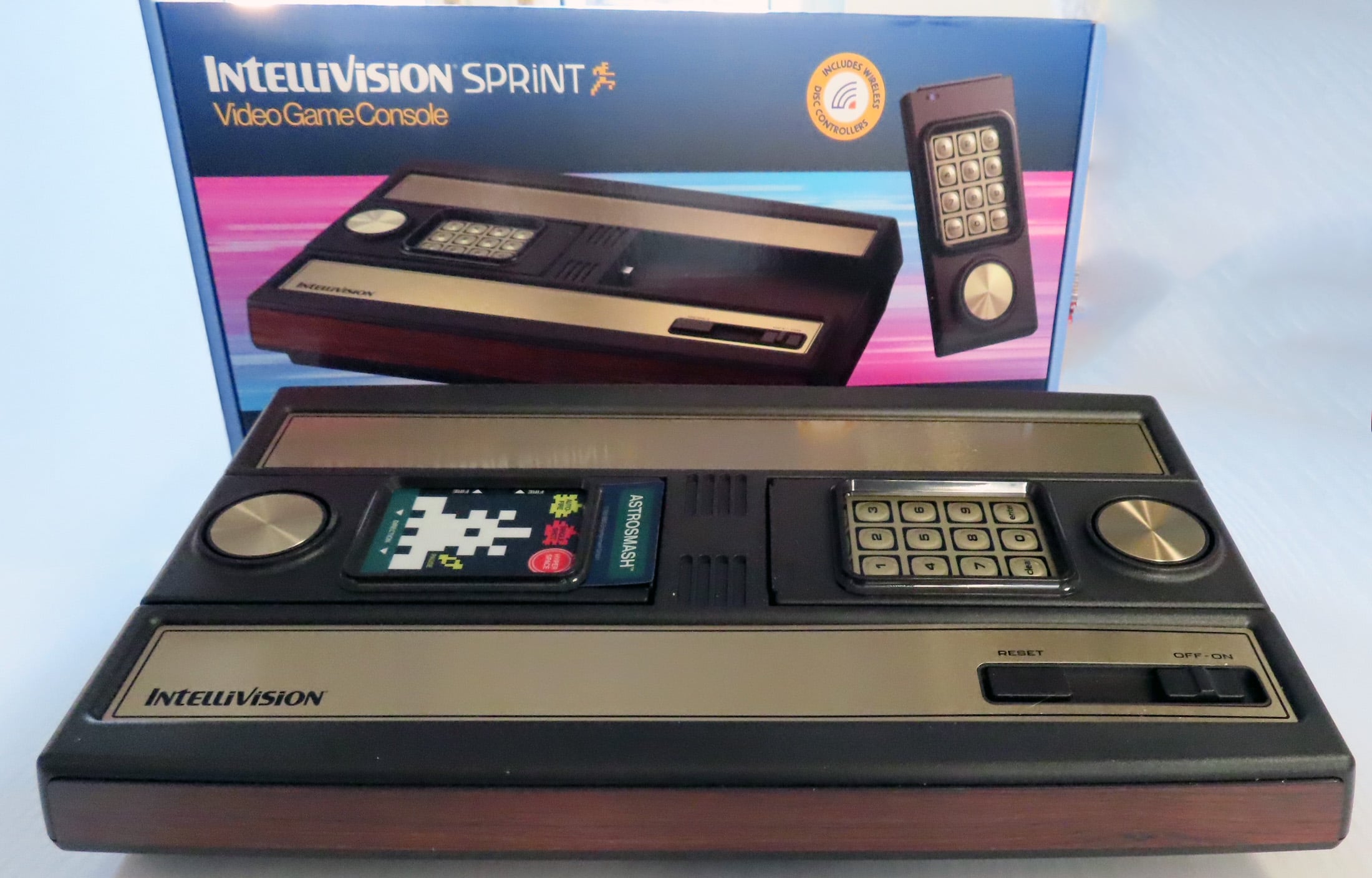
Holding my hands up, I don’t know why it is called the Sprint – I am speaking with the team behind it in the next few days, so I will bring you more on the story behind it then. But what we have is a console that is such as accurate rendition of the original, from a distance you could mistake it for the real thing.
On closer inspection, the unit is smaller, as you can see from my images, and there is no cartridge slot. The back panel reveals USB ports and an HDMI out, while the controllers, which look so faithful, have a series of LEDs at the top that point to the Sprint’s most exciting feature – wireless controllers. Pairing the controllers to the print is easy, and when you dock them, they mate with a USB-C connector, which handles charging them up.
As an original aficionado of the Intellivision, I love that the creators have decided to add the quality-of-life feature of a power LED – of course, the original didn’t have one; you could only tell the console was on by the switches’ position. It would have been so easy to think the Sprint needed one, but within two days, I had accidentally left it switched on overnight, like I did so many times in the 80s. How is this a good thing? It just is. Trust me. The Sprint is about the memories for me.
One other minor change is in the branding. Gone are the Mattel Electronics logo and Intelligent Television wording on the gold plate, leaving behind just the Intellivision logo. Sad, but a sign of the times.
Intellivision Sprint games
The machine comes pre-loaded with 45 games, including many of the classics, but sadly excluding a lot of the games I played, which were from third parties or even licensed games that Mattel published itself. There is no TRON: Deadly Discs or Advanced Dungeons & Dragons: Cloudy Mountain, or even Pitfall!, three of my favourite games. I’ll sort that out shortly, though.
There are plenty of great games here, such as Astrosmash and even Sub Hunt, to keep you reminiscing for a long time, and the fact that it is just literally an HDMI out and switch the thing on is exciting. One really cool aspect is that you get new overlays for the included games which slide into the controllers just like yesterday.

I hunted around Thingiverse and found an overlay holder in the shape of an Intellivision cartridge to store them all, rather than the cardboard box supplied.
Using the Intellivision Sprint on a CRT
The first thing I hooked the Sprint up to was my PC monitor, which is a 49″ ultrawide, and it was ridiculous to see Intellivision games at that aspect. Changing the display between 4:3 and 16:9 didn’t make a world of difference, and it was obvious this solution was not how I was going to use my Sprint.
The thing is, I don’t even really want to use it on a monitor anyway. I don’t want crispy graphics, most people probably will, and that’s absolutely fine, but I want to use my Sprint as a replacement for my original hardware, in the hopes that it will survive the ravages of time that bit longer, so I needed a solution to hook it up to an old 14″ portable TV that has RCA jacks on the front. Something that will still give me a better picture than my original console ever could, but have enough CRT about it to make it legit.
I picked up a cheap HDMI to AV converter from Amazon, plugged the HDMI into that, and then used phono cables to the TV. Nothing worked, although I could occasionally see the image flick into life. The converter has a power input, so I plugged a power bank and USB cable into it, and the Sprint image appeared on my CRT like it was 1990 all over again. It was a beautiful moment.
Sideloading games on the Intellivision Sprint and the UI
If you boot from stock, you get a carousel of the 45 included titles that you use the disc on the controller to scroll through, and you get some images, snaps, and info about the title. Pressing Enter boots you into the game and the Reset button takes you back again.
The single best bit of the Sprint, however, is the ease of sideloading the entire ROM library, but just putting it on a USB and rebooting. The Sprint will read the USB and present your on-stick games rather than the in-built library, so if you want, currently at least, although there is talk of the devs changing this, to see all the library, you will need to include the games on your Sprint already, on the USB. The onboard games do not show up when you plug a USB in.
All of these sideloading games generally work just fine. The caveats are that you don’t have overlays for the controller, and you are missing all the metadata for the UI. Step forth the community who have already come up with the Sprint Game Manager, which makes it easy to add your own images, box art and the like and copy it to your USB to show up.
We have had a day one firmware update, and there is, at the time of writing, a beta version out there which extends the functionality further, allowing you to put your collection into folders. For example, I have my games grouped by publisher, eg Mattel, Imagic and the like, and then you can keep the initial screen a little less overhwhelming.
Work is also being undertaken to provide custom color palettes as old players like me are seeing a few inaccuracies in game colors.
I’m busy now creating images for all these folders to make it look pretty. I do this, though, end up more in the UI than ever playing the games, although I think this time it will be different.

Overlays for sideloaded games could remain an issue, although there is the option to upload them to the UI so you can see them at any time you need to. The controllers are the same size as the original ones, and you can see in the image above, the original Tron overlay from the early 80s in the sprint controller. That’s pretty cool if you have any for games you want to play or find them on eBay.
I’m excited to see upcoming versions of the firmware, although some people are having issues with the machine not reading certain USB sticks or formatting types, and there is, as yet, no definitive explanation as to what works and what doesn’t. I am unsure how much is just user error because I have done it twice with different sticks, and it’s worked both times perfectly.
Is the Intellivision Sprint worth it?
I can answer this one without swathes of tension-building drama. Unequivocally yes, although I say that as a lover of the console from the off. The Intellivision is worthy of its place in history for its battle with Atari and for some genuinely groundbreaking games at the time. Games like Utopia can be traced back to the original God game when Peter Molyneux was just a child like me.
Costing just £100 in the UK and the equivalent after conversion in the US, the Intellivision Sprint is a modern version of this classic, important machine. The attention to detail recreating the look and feel of the original console is outstanding and has clearly been a labour of love. The only thing that feels different is the controller, because it uses actual switches rather than the spongy membrane of the original.
I know I have a deep mental attachment to the Intellivision, but for people like me, and strangely, Clown from Slipknot, the console was more than part of our childhoods. That makes the Intellivision Sprint an essential purchase, and one that, with the help of the community, will get better and better.
To non-Intellivision fans, it may always be that quirky wood-grain and gold loser of the console war, but I’d rather play this than the Atari VCS any day.